How ASEAN Quietly Rewired Global Manufacturing


The Hidden Winner of the US-China Trade War
The US-China Trade War, which started in 2018, has widely been seen as a showdown between two global superpowers. Commentators tracked every tariff, every retaliation, every political statement. But while the world fixated on Washington and Beijing, something else was happening quietly in the background.
Shipping containers stacked high at the ports of Vietnam. Factories in Thailand hummed with new production lines. Malaysia's tech sector has been steadily expanding. These are all signs that the ASEAN countries (Association of Southeast Asian Nations) have been quietly reaping the benefits. In fact, U.S. imports of electronics from Vietnam rose from about US$12.2 billion in 2018 to nearly US$50 billion by 2022, a more than four-fold increase.
When supply chains move, so do investment flows, manufacturing jobs, and geopolitical influence. Understanding these shifts raises an important question: how can smaller or secondary economies turn a major-power tariff conflict into an opportunity for growth?
This article will explore how countries like Vietnam, Thailand, Malaysia, and Indonesia, among others, turned global tension into economic opportunity. By attracting foreign investment, growing exports, and coordinating regionally, Southeast Asia emerged as the unlikely winner of a conflict originally thought to involve only China and the United States. The tensions may have made headlines for the wrong reasons. The real story was happening in the ports, factories, and policies of ASEAN nations.
Strength in Unity
When the US–China trade war heated up in 2018, many expected countries across Asia to face the same shock and economic volatility. And many did. Taiwan, South Korea, and Japan, all export-driven economies, found themselves in difficult positions as global supply chains tightened. Their production networks were deeply tied to China, meaning that when the United States imposed tariffs on Chinese goods, the disruption spilled over to their economies as well.
South Korea offers a clear example. As a major exporter of semiconductors, much of its output feeds into Chinese manufacturing before reaching final markets like the United States. When US tariffs reduced Chinese exports, demand for Korean semiconductors weakened too, even though South Korea itself wasn’t directly targeted. Lacking a shared trade framework or regional coordination comparable to ASEAN, the country was forced to absorb the shock largely on its own through bilateral responses.
Without a unified regional strategy to rely on, countries like Korea had to navigate the fallout individually. ASEAN, on the contrary, took a different path.
ASEAN (Association of Southeast Asian Nations) is an 11-member regional bloc formed in 1967 to promote political stability and economic cooperation. Its members include Brunei, Cambodia, Indonesia, Laos, Malaysia, Myanmar, the Philippines, Singapore, Thailand, Vietnam, and most recently, Timor-Leste. The bloc has spent decades building a partnership based on communication, trust, and low-barrier trade agreements. That collective identity mattered a lot during the trade war. While other Asian economies were forced into reactive positions, ASEAN used its unity as an advantage.
Instead of playing politics, ASEAN member states leaned into strategic coordination. They expanded existing trade agreements, signed new ones, and signaled to global companies that the bloc would remain stable and predictable despite rising global tensions. One specific example is the Regional Comprehensive Economic Partnership (RCEP), the world’s largest trade agreement, which includes China, Japan, South Korea, Australia, and New Zealand. By acting as the central negotiating hub, ASEAN helped lower trade barriers, simplify rules of origin, and keep supply chains moving across the region at a time when US–China trade was becoming more fragmented. This created an alternative pathway to stability while the two superpowers were locked in tariff disputes.
Even at moments when China and the US were locked in aggressive tariff hikes, ASEAN avoided escalation. This calm, cool, and coordinated stance, compared to the uncertainty in non-ASEAN economies, made the region more appealing and stand out as a safer long-term option for supply chains. Global investors and companies took notice of this.
Foreign direct investment (FDI) into ASEAN climbed significantly during and after the tariff dispute years. According to UNCTAD data, total FDI inflows rose from roughly US$150 billion dollars in 2018 to a record US$230 billion dollars by 2023. To put that in perspective, ASEAN’s share of global FDI averaged about only 6% between 2006 and 2015. By 2023, that number had jumped to 17%. While global investment fell or stagnated in many regions, Southeast Asia became one of the few areas where capital accelerated.

So why did this happen? Because ASEAN acted together in ways individual countries simply could not. The bloc used trade diplomacy to keep markets stable, avoided politics and retaliation that would scare off investors, and presented a unified message: Southeast Asia was open for business. Even internal, domestic political differences did not break this front. Global investors saw the region as coordinated, reliable, and increasingly modernized.
But, this doesn’t mean that every ASEAN country benefited equally. Nations with stronger infrastructure and clearer regulatory environments, like Vietnam, Malaysia, and Indonesia, absorbed most of the gains. Meanwhile, countries with lesser-developed economies or internal political struggles, such as Myanmar and Laos, saw limited inflows. Nonetheless, the broader point holds. ASEAN’s ability to respond as one created regional momentum that individual countries elsewhere in Asia couldn’t replicate.
By the time the trade war went for long enough to the point where it reshaped global supply chains, Southeast Asia had already positioned itself as the most viable alternative to China. Its coordination did not completely eliminate risk, but it certainly lowered it. And in a world where stability is rare, that was enough to transform ASEAN into one of the biggest unexpected winners of the US-China trade tensions. That low risk became the final push global firms needed to begin shifting production.
Factories on the Move
Long before anyone had heard the phrase “trade war,” global manufacturing already had cracks forming beneath the surface. Companies were growing uneasy about keeping so much of their supply chain in one country, especially as production costs in China continued rising year after year. It took the sudden spike in US tariffs under the Trump administration to turn those concerns into actionable steps. Overnight, companies that clung to Chinese production for decades were forced to wonder if they should relocate.
For many firms, Southeast Asia became the answer not by accident, but because it already checked many boxes. The region had a large and cheap labor force, rapidly improving infrastructure, and governments that had spent years positioning themselves as friendly to global investment. By the time tariffs started adding millions in extra costs for companies, the region was already standing in the doorway, ready with alternatives.
What made this shift very noticeable was that firms didn’t relocate in small, experimental steps, but in clear, deliberate investments. Electronics suppliers began transferring assembly lines. Major apparel and footwear brands started building new cutting and sewing operations, and much more. These weren’t just symbolic moves. They were permanent adjustments to global strategy.
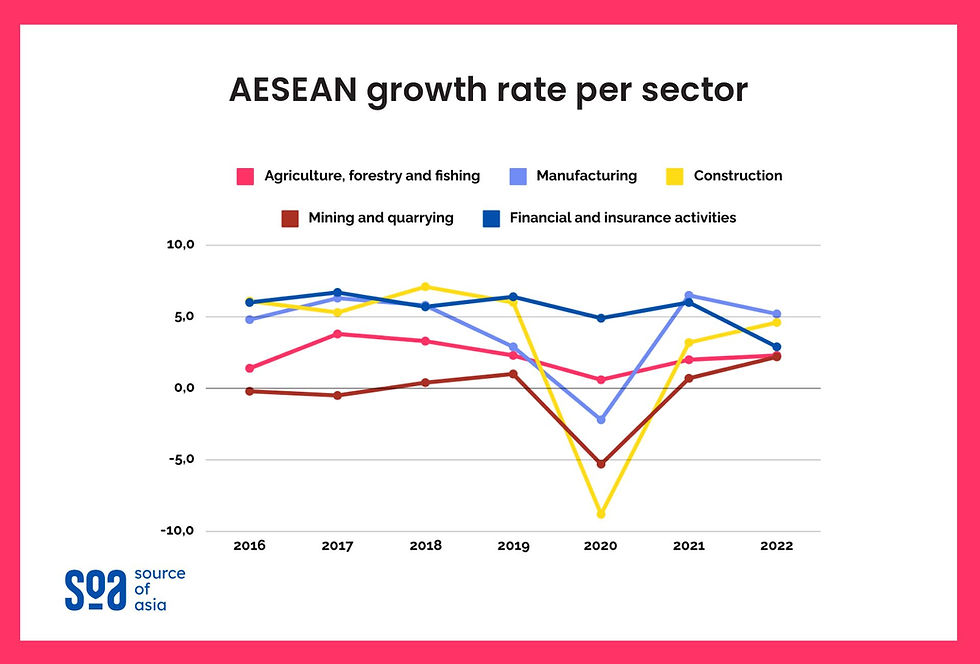
Electronics and semiconductors lead overall investment. Some companies adopted a “China + 1” model, keeping main operations in China, but moving additional operations to ASEAN countries to lower risk. Others went even further, building entire new product lines in ASEAN to avoid tariff exposure entirely. Industry analysts noted that production footprints were shifting rapidly in sectors where moving equipment and training workers could be done quickly.
For many firms, the attraction was more so about predictability rather than just financial savings. Investors valued the straightforward permitting processes and clearer export rules that many ASEAN countries had developed. In a moment when companies were suddenly worried about political risk, Southeast Asia offered a region where long-term planning felt predictable.
The end result was that the region evolved from being a “backup option” to becoming a central part of global supply chains. The trade war didn’t necessarily create these strengths, but it did spotlight them. Once companies began moving production and saw that the region could support stable, large-scale operations, the momentum built on its own.
By the time the disruptions of the global conflict settled into a new normal, Southeast Asia had firmly established itself as the world’s next major manufacturing base, not because it wanted to replace China, but because the world needed more than one place to build. The result was a true second hub for global production, built on the distinct strengths each ASEAN country contributed.
Different Countries, Different Wins
One of the most overlooked reasons for the main argument is the range of industries already operating across the region. Companies leaving China were not all looking for the same production base. Some needed electronics capacity. Others needed consumer goods, auto parts, or semiconductor production. Very few regions outside China could offer options across all of these areas. Southeast Asia could.
Vietnam became the face of this transition. Electronics and textile manufacturers flocked there, helping the country's exports to America increase by over 22.5% in just one year, according to Reuters. Major suppliers for large brands like Apple and Nike accelerated their expansion plans far earlier than analysts expected. Industrial parks outside Hanoi and Ho Chi Minh City filled up so fast that some regions reported land shortage for new factories.
Malaysia emerged as another winner, mainly in high-tech production. The country’s semiconductor industry saw a surge in investment as companies sought alternatives to China’s tightening regulatory environment. Penang, nicknamed “the Silicon Valley of the East,” recorded its highest level of manufacturing in over 11 years, according to InvestPenang. In Johor Bahru, the southern state bordering Singapore, multinational firms are investing heavily in data infrastructure.
Thailand also benefited as car manufacturers and parts suppliers increased capacity to serve global auto companies seeking to diversify supply chains.
The overall diversity reduced bottlenecks and other production issues. Countries were not competing for the same factories, so as a result, wage pressure stayed manageable and expansion happened more smoothly. Companies also had more flexibility, which lowered the risk of moving production out of China.
Over time, this variety of industries became one of ASEAN’s biggest competitive advantages. As more companies arrived, each country refined what it was already good at instead of trying to become a copy of its neighbors. China had strength because its production was concentrated in one place. ASEAN gained strength because production could be spread across many places. That ready made diversity allowed Southeast Asia to benefit from the trade war in ways other regions simply could not.
The Road Ahead Isn’t Without Hurdles
ASEAN’s gains during the global trade war are certainly significant, but they do come with some risks. Rising labor costs, over the past few years, are gradually narrowing the region's cost advantage compared to China, and supply chains in many countries within ASEAN remain dependent on some Chinese goods. While Southeast Asia offered a diversified alternative to China, it still relies on Chinese materials for electronics, and other key sectors. These dependencies mean that the region's success is not guaranteed to be permanent.
Long-term success will depend on policy, regional integration, and investor confidence. ASEAN’s diversity of industries reduces bottlenecks, spreads risk, and allows countries to build on existing strengths rather than directly compete with each other. Sustaining this advantage requires continued investment in infrastructure, supply chain management, and labor development.
Lastly, the region’s appeal also somewhat stems from perception. ASEAN presented itself as coordinated, predictable, and business-friendly, while America and China were dealing with tariffs and uncertainty. That stability attracted companies seeking long-term reliability. The trade war highlighted Southeast Asia’s strengths and accelerated its rise as a hub of production, but turning these gains into lasting advantage will require maintaining the policies, industries, and trust that made the region attractive in the first place.
All in all, ASEAN’s experience during the US-China tariff conflict offers a broader lesson about how secondary economies can navigate such shocks. By acting collectively, maintaining policy stability, and leaning into sector diversity, the region showed how economic influence depends on more than just size and power. It also depends on coordination and adaptability.
Looking ahead, the challenge will be turning this momentum into lasting progress. Policymakers must continue deepening regional integration, upgrading labor skills, and reducing reliance on single-source inputs, particularly from China. At the same time, the region’s citizens will ultimately judge success by whether growth leads to higher wages, stronger institutions, and inclusive development. The trade war created the opening, but ASEAN’s future will depend on how effectively it converts short-term opportunity into long-term economic transformation.
References:
Luo, Wei, Siyuan Kang, and Qian Di. Global Supply Chain Reallocation and Shift under Triple Crises: A U.S.–China Perspective. arXiv, Aug. 2025, arxiv.org/abs/2508.06828.
McKinsey & Company. “Made in Southeast Asia.” Week in Charts, 11 Oct. 2024, www.mckinsey.com/featured-insights/week-in-charts/made-in-southeast-asia.
Reuters. “Vietnam’s US Exports Account for 30% of GDP.” 25 Feb. 2025, www.reuters.com/markets/vietnams-us-exports-account-30-gdp-making-it-highly-vulnerable-tari ffs-2025-02-25.
UN Conference on Trade and Development. ASEAN Investment Report 2025.
UNCTAD, 2025, unctad.org/publication/asean-investment-report-2025.
UNCTAD. “Southeast Asia: Foreign Investments Resilient Despite Global Economic
Uncertainties.” UNCTAD,
unctad.org/press-material/southeast-asia-foreign-investments-resilient-despite-global-economic-u ncertainties.
FastBull. “Vietnam’s Electronics Exports to the U.S. Surpass $18 Billion.” 2025, www.fastbull.com/news-detail/vietnams-electronics-exports-to-the-us-surpass-18-4337041_0.
Vu, Khanh, and Francesco Guarascio. “Vietnam’s Trade Surplus with US Hits Record as Exports Surge despite Tariffs.” Reuters, 6 Dec. 2025,
U.S. International Trade Commission. (2023). U.S. general imports of electronic products by selected trading partners, 2018–2022.
https://www.usitc.gov/system/files/research_and_analysis/tradeshifts/files/electronic_products_2 022.pdf?


