Losing Paradise: Pacific Climate Change Finance Bottlenecks

In Funafuti, Tuvalu, the white sand beaches, balmy weather, and glassy blue waters seem like paradise. Yet, the global warming crisis that the islets face are anything but perfect. Tuvalu’s central government, lacking the financial resources to reclaim the land eroded by the sea, laments the impending loss of culture, governmental infrastructure, and statehood as a whole. Fongafale, the largest island of Tuvalu, had narrowed by several meters in critical sections. The main airstrip—the country's only runway—sits just feet from the high tide line. During storm surges, waves have been known to wash completely across the island's narrowest points, saltwater flooding roads and homes. For climate change’s biggest financiers in the West, stories like Tuvalu’s are hardly platformed. This lack of platforming actively shapes which problems receive funding, which solutions get prioritized, and which nations are expected to wait their turn. Media invisibility to the issue of climate finance, after all, limits political pressure from donors and attention defaults to visible crises. Intersectional and systemic root causes—limited capital, weak institutional capacity, and funding systems built for continental nations—explain why Tuvalu remains waiting in the wings.
To understand where the money stops, it helps to first understand what capital Pacific Island nations are working with. Most countries are small in land mass, limiting the available natural capital. The World Bank reports that Pacific Island nations like the Solomon Islands are isolated from major trade partners. The Asian Development Bank, as seen in Figure 1, reports that these factors strain the possibility of development (“Pacific Approach”). Take Vanuatu: with its nearest major trade partner, Australia, over a thousand miles away, even essential goods like medicine and food must be imported at great cost. When a government's budget is consumed by importing basic necessities, there is little left to invest in its own growth, let alone, climate change.

Figure 1: Asian Development Bank
Pacific nations’ financial institutions are evidence of exactly that limited breathing room. The World Bank reported in 2023 that the financial systems within most Pacific countries are underdeveloped (Baltabaev, D’Hustler 2023). Financial systems are vital for efficiently building and protecting the personal wealth of citizens, and provide loans for business growth. In the case of the Pacific Islands, the lack of a sophisticated financial system is a chokepoint. Kiribati, for example, has no domestic financial authority, and the banks that do exist are unregulated. The Kiribatan government, as seen in Figure 2, has no mechanism to allocate its capital, including any external climate capital. When climate funds are transferred to Kiribati, they often sit in foreign accounts or are managed by outside intermediaries, because the domestic tools to disburse, monitor, or audit those funds simply do not exist.
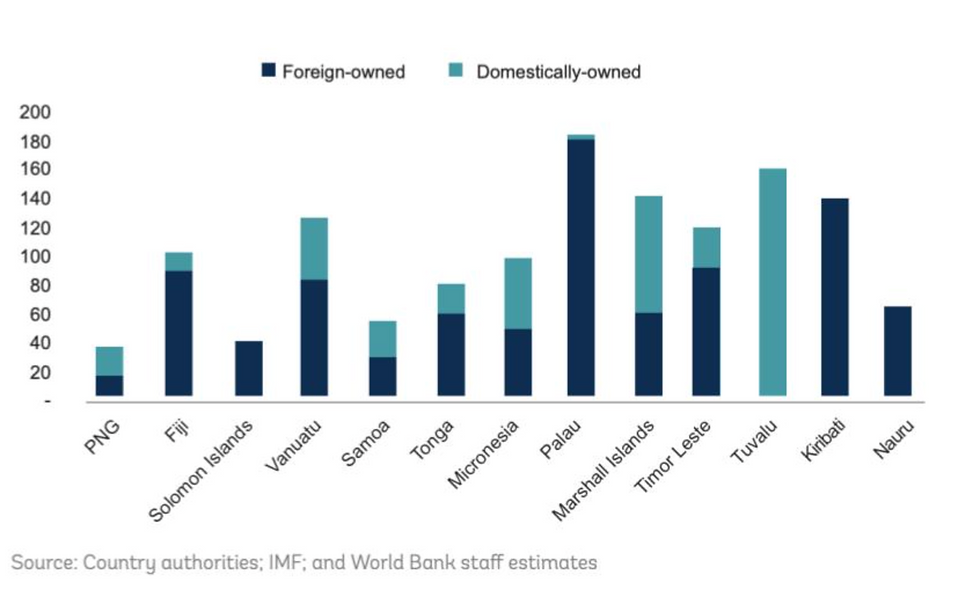
Figure 2: Banks as Percent of Pacific Island GDP (World Bank)
For the climate capital projects that do get researched and developed, there are still gaps in application. One-size-fits-all solutions, directed from a global stance, may not work, and this critically applies to infrastructure. The United Nations Office for Disaster Risk Reduction recommends that Pacific islands might benefit from green infrastructure, like “use plants, reefs, sand, and natural barriers to reduce erosion and flooding, while maintaining natural shoreline processes.” (“Thematic Report…”). However, researchers at the University of Gottingen found
that the type of climate change-resistant infrastructure that Pacific islands actually use is often derived from continental nations (Nunn, McNamara 2019). For example, shoreline protection structures, like seawalls, are constructed in Western countries to protect property and people, and are received with much success. But for Pacific islands, which have different weather patterns, water-deposit dynamics, and the pessimistic economic potential for upkeep, these structures are likely to fail. Failed infrastructure is not only a major economic loss for Pacific countries with limited resources; it could be a devastating, permanent loss of land. Yet, the designs continue to be funded because donor nations and multilateral funds favor infrastructure that is visible, measurable, and resembles projects back home. A seawall can be photographed and counted; green infrastructure is harder to quantify, even if it works better.
Even when funding is technically available, the administrative process of securing said funding is next to impossible. The Green Climate Fund, the financial mechanism for the United Nations to distribute climate aid to developing countries, is the primary way for Pacific islands to receive funding. However, in recent years, the Green ClimateFund’s own Independent Evaluation Unit, found in its annual audit that Pacific Islands face unique challenges in accreditation (IEU, 2023).
To access the millions of dollars in climate aid, non-governmental organizations, governmental bodies, or private groups must be accredited to see if it has the capacity to operate its climate change projects. The process of accreditation is lengthy (see Figure 3), involving three stages and eleven steps, requiring a swath of dedicated legal, fiduciary, and social experts to complete (“The Accreditation Process…”). Given the requirement for experts to be working on the accreditation process, in countries with limited administrative labor, there are limited accredited bodies to platform Green Climate Fund aid. For a nation like Tuvalu, where the entire government employs only a few hundred people and no single ministry has a dedicated climate finance legal team, assembling even one accreditation bid can paralyze other necessary functions. The money flow is evident of this: of the over 20 billion dollars that the Green Climate Fund provides, a measly 5% reaches Pacific Island governments (Green Climate Fund Open Data Library). Accreditation actively filters out the very local organizations most likely to design effective, community-specific projects.

Figure 3: Green Climate Fund Application Process (Green Climate Fund)
Meanwhile, accreditation favors large international NGOs and bodies that are least connected to community needs. As previously mentioned, effective climate reduction projects in Pacific Island countries are tailored to the local community. Contrarily, the Green Climate Fund’s system “prioritizes government control of climate finance at the expense of meaningful engagement of sub-national actors” and “government structures are notoriously slow to take action and respond to local needs” (Kuhl and Shinn, 2022). Therefore, projects that do reach the Pacific Islands are surface-level, and inefficient in truly combatting the pressing effects of climate change.
Critics may argue that the Green Climate Fund’s rigorous accreditation process is a necessary safeguard against corruption, mismanagement, and failed projects. After all, climate finance has been suggested to be correlated with an increase in corruption, according to the Journal of Environmental Management (Wang, Njangang 2025). From this perspective, the Green Climate Fund’s three-stage, eleven-step accreditation process—which requires dedicated legal, fiduciary, and social experts—exists to protect both donor nations (whose taxpayers want their money to be used for good) and recipient nations (who need projects that truly work). Without such safeguards, the argument goes, millions of dollars could vanish into corrupt bureaucrat hands, or build up poorly designed infrastructure, leaving the intended beneficiary no better off than before. The burden, therefore, falls on Pacific Island governments to build its own administrative capacity over time, just as larger developing nations have done.
However, climate change is an issue that cannot wait. Pacific island nations do not have the luxury of building administrative capacity “over time.” The World Meteorological Organization reports that sea levels and water temperatures are rising faster in the Pacific than elsewhere in the world since 1980
(“Climate change transforms”, 2024). In places like the Gizo Market in the Solomon Islands, seen in Figure 4, waves actively erode critical infrastructure for daily life. Waiting ten to fifteen years to slowly build a central bank, train a legal team, and qualify for funding is impractical for Pacific nations. Climate finance is not ordinary development aid, but emergency funding. Yet, the system for these funds does not reflect that urgency.

Figure 4: Gizo Market (Australia Pacific Climate Partnership)
Addressing the systemic marginalization of Pacific nations requires an immediate reframing of what Pacific Islands need, with a focus on speed, localization, and genuine partnership. One immediate solution is a fast-track accreditation window within the Green Climate Fund (Green Climate Fund), specifically designed for Pacific small island states. Under this window, the accreditation process would be reduced from its current three-stage, eleven-step structure—which can take over two years—to a streamlined, four-month process for eligible national and local entities.
The Green Climate Fund's existing Accreditation Committee would oversee the fast-track window, but with a dedicated Pacific desk staffed by both Green Climate Fund personnel and seconded experts from regional bodies.This joint governance ensures both global fiduciary standards and local contextual knowledge.
The Green Climate Fund itself would fund the fast-track window through focusing its existing readiness and preparatory support program, which already allocates grants for capacity-building, to Pacific Islands. Additionally, Australia and New Zealand—as regionally developed nations with a direct interest in Pacific stability—would contribute, using a small fraction of their existing climate finance commitments. No new funding architecture is required.
The fast-track window does not waive any substantive fiduciary, legal, or social standards. Instead, it accelerates accreditation by (1) allowing Pacific entities to submit a single, consolidated application instead of eleven separate documents, (2) providing pre-qualified technical experts (paid for by the readiness and preparatory support program) who assist local staff in meeting due diligence requirements, and (3) introducing a post-accreditation audit mechanism: newly accredited entities receive initial funding in tranches, with each segment released only after independent spot-checks by the Green Climate Fund's Independent Integrity Unit. Thus, corruption safeguards are front-loaded and verified in real time, rather than requiring years of documentation before a single dollar moves.
Pairing the existing local workforce with these dedicated experts when filing for accreditation—and contributing to the creation of locally tailored proposals—would provide Pacific Islands with the infrastructure necessary for climate change adaptation. This approach does not remove the safeguards that the Green Climate Fund's accreditation intends; rather, it recognizes the urgency that climate change aid for the Pacific Islands requires, while maintaining full integrity over how funding is used.
In Tuvalu, and the rest of the Pacific Islands, the threat of climate change are the result of intertwined limitations in capital, institutional capacity, and access to funding structures that were never designed with them in mind. As a result, even well-intentioned climate finance mechanisms fall short, favoring visibility, scale, and administrative ease over locally effective and urgently needed solutions. While safeguards and standardized processes may protect investments, they also slow action to a pace that Pacific nations simply cannot afford. Climate change in the region is an immediate and escalating emergency. Without giving Pacific nations direct control over funding decisions and radically simplifying accreditation requirements, countries like Tuvalu will continue to face disproportionate consequences. Ultimately, confronting this imbalance requires a shift in global priorities, ensuring that those most affected by climate change are at the forefront of decision making.
Works Cited:
Annual Report 2020. Green Climate Fund. (n.d.).
https://ieu.greenclimate.fund/sites/default/files/page/210220-ieu-annual-report-2020-com pressed.pdf
Climate and disaster-resilient infrastructure in the Pacific (89310). UNDRR. (n.d.). https://www.undrr.org/media/89310
Climate change transforms pacific islands. World Meteorological Organization. (2024, September 2).
Financial Stability Report, 2023, Pacific Islands. The World Bank, 2023.
https://documents1.worldbank.org/curated/en/099121125002020124/pdf/P174933-886a5 74e-674c-4aa8-8866-8dfbe4d75564.pdf
Green Climate Fund. 2026. Green Climate Fund Open Data Library. [Data set]. Green Climate Fund. https://data.greenclimate.fund/public
Kuhl., L. & Shinn, J. (2022) Transformational adaptation and country ownership: competing priorities in international adaptation finance, Climate Policy, 22:9-10, 1290-1305, DOI: 10.1080/14693062.2022.2104791
Nunn, P.D. & McNamara, K.E. (2019): Failing adaptation in island contexts: The growing need for transformational change. In: Klöck, C. & Fink, M. (eds.): Dealing with climate change on small islands: Towards effective and sustainable adaptation? (pp. 19–44). Göttingen: Göttingen University Press. https://doi.org/10.17875/gup2019-1210
The Pacific Approach 2021-2025. Asian Development Bank. 2021.
https://www.adb.org/sites/default/files/institutional-document/712796/pacific-approach-2 021-2025.pdf#:~:text=Core%20Challenge%201:%20Vulnerability%20to%20Shocks%20 Although,capacity%20constraints%2C%20including%20of%20its%20health%20systems
The accreditation process of the Green Climate Fund. Republic of Macedonia. (n.d.). https://openknowledge.fao.org/server/api/core/bitstreams/ff1c2001-e47f-46ab-8604-9e43 2d14a50e/content
Wang M., Njangang H., The unexpected outcomes: how does climate finance affect corruption in developing countries?, Journal of Environmental Management, Volume 389, 2025, 126065,ISSN 0301-4797, https://doi.org/10.1016/j.jenvman.2025.126065.


