A Homeowner’s Guide to Navigating the Nuclear Renaissance

On April 26th, 1986, the explosion of reactor number four at the Chernobyl Power Plant singlehandedly shifted the global perception of nuclear energy. The ensuing radioactive fallout killed thousands, and the surrounding area was left uninhabitable. It marked an important moment in humanity’s race for nuclear energy. What once seemed like a miracle strategy for energy production was branded as untouchable for decades. Today, however, the narrative is being rewritten at the advent of the AI revolution. Technology has improved and energy needs have increased, making nuclear energy an enticing solution. This is largely driven by the massive electrical requirements to power artificial intelligence, which demands a power input that only nuclear energy can provide. The public is much more in favor of nuclear power in the modern day, with an annual survey conducted by the Nuclear Energy Institute (Figure 1) finding that 76% of Americans report favorability towards nuclear energy production, far higher than the 49% reported in 1983 (Johnson).

This trend indicates that the stigma around nuclear energy is shifting, and power plants are likely to be constructed in neighborhoods across the United States. The issue is that the fear around nuclear meltdowns has not entirely dissolved, and as homeowners watch as nuclear power plants are constructed down the street from their homes, their reactions range from reasonable to extreme. Historical fear now weighs against the promise of modern infrastructure. Understanding this balance is essential for anyone to track how energy policies affect the real estate industry. Nuclear plants may bring significant tax contributions and attract lucrative jobs, but they can also drive economic disaster. Ultimately, despite the risks they bring, nuclear power plants are a net positive for homeowners as they are a driving force in neighborhood property valuations.
Property values wax and wane as the stigma of nuclear energy and the tax subsidies accompanying a nuclear power plant are weighed by residents. The main benefit nuclear power plants bring to neighborhoods is massive tax contributions. These plants are typically built on large plots of land, which are a significant source of revenue for local governments through property taxes. Nuclear power plants are also often subject to utility taxes on their sale of electricity, which also go towards the local government. These tax contributions lower property taxes on other properties, as the governments’ tax quota is already met. This lowers the tax burden on homeowners because the power plant’s property taxes contribute most of the funding towards the local government’s fixed costs. The Zion Nuclear Power Plant in Illinois supports this, where at its peak, the plant accounted for 55% of the local government’s tax revenue (Munro, 2018). Lowered property taxes are extremely beneficial to residents, but they often overlook these benefits because of the stigma surrounding nuclear energy. People are less likely to purchase homes near these energy sources, even though they are low risk. The Zion Plant illustrates this trend perfectly: residents were too focused on the stigma of the plant while ignoring its financial benefits. Only after its closure did property values drop 11.5%, proving that the economic benefits were present but not within the public eye. Fortunately, nuclear energy generation is much easier to hide than other forms of energy. Figure 2 shows that a single pellet of uranium an inch tall has a comparable energy output to 149 gallons of oil, 17,000 cubic feet of natural gas, or a ton of coal (Dieter, 2025).

Nuclear energy’s physical footprint is extremely minimal. As nuclear energy is more compact than its fossil fuel counterparts, it is easier to conceal a plant within a neighborhood. When a facility is kept out of direct public view, the daily reminder of the plant is eliminated, and if power plants are kept out of public view in this way, their negative impact on taxation is minimized.
Nuclear waste transportation is an additional threat to property valuations. It is shown to lower real estate prices due to public perceptions of the risk they bring. It is important to note that it does not matter if these perceptions are accurate or not, as when nuclear waste transportation is hidden, property values are not negatively impacted. The mere sight of trucks hauling nuclear waste out of a neighborhood is enough to make residents turn up their noses and leave. To the public, it is less about the actual threat of a nuclear fallout, but more about the stigma surrounding one. In a case study of the Diablo Canyon Nuclear Power Plant, it was found that “any negative property value impacts resulting from perceived risks associated with the plant do not overwhelm accessibility and other desirable attributes, which are correlated with proximity to Diablo Canyon” (Bezdek, R.H. and Wendling, R.M., 2006). This study shows that the existence of power plants themselves does not decrease property values; they just need to be implemented in a way that does not scare residents.
The integration of nuclear energy and artificial intelligence can significantly drive property values by attracting high-paying jobs to the surrounding area. As noted in the McKinsey 2023 report ‘The State of AI’, AI is becoming increasingly popular and requires extreme amounts of energy. Nuclear energy, due to the incredible amount of power, is the most prominent energy source for these technology centers. Figure 3 shows that in 2025, 54 gigawatts of energy were demanded by AI, a number projected to reach 145 gigawatts by 2030 (Hanwha Data Centers, 2025).

To meet this power demand, the 2025 Trinity Street Capital Partners end-of-year report shows a trend of AI data centers relocating to nuclear energy sources because of the incredible amount of energy they offer in comparison to other modern energy alternatives. Data centers then attract jobs in tech and other relevant industries, increasing housing demand and therefore property values as well. Nuclear power plants typically employ 500-800 workers, who, as of 2021, “have a median salary 52% higher than the median hourly wage for all jobs in the electric power generation industry” (Nuclear Energy Institute, 2021). These workers are sourced from outside of the neighborhood due to their unique areas of study, and as they are higher income individuals, they typically spend more on local services, retail and dining. This makes the neighborhood look more desirable by stimulating economic activity. Higher-quality restaurants and larger clothing stores are some of the most enticing things to potential residents, after all. Higher salaries additionally allow individuals to qualify for larger mortgages, raising the ceiling of what they are willing and able to pay. Property valuations then increase across the board. As the neighborhood becomes increasingly upscale, the amount of money the government receives from taxes increases as well. These tax dollars are then reinvested into schools, parks, and public services. As parks are cleaned, transportation is optimized, and schools are improved, the attractiveness of the neighborhood increases, and property values increase in tandem. This effect is best shown through the benefits of the Indian Point Energy Center in Buchanan, New York. The plant singlehandedly contributed “approximately half of Buchanan’s operating budget ($4 million), 5,300 local jobs from direct and indirect sources, $25 million in annual school taxes, etc” (Meher, 2020).
The issue with nuclear power plants no longer lies in the risk of a reactor meltdown, but instead in economic crashes. Every plant has a lifespan (60-80 years), and when one shuts down, industries—like Artificial Intelligence—that depend on its power fail, causing a massive decrease in the number of available jobs. These shutdowns occur due to the increasing maintenance cost that comes with older infrastructure. Just as nuclear power plants attract jobs in technology, their sudden absence causes these jobs to disappear. Residents who relied on these high-income jobs are then left with mortgages that are now impossible to pay, forcing them out of the neighborhood. This phenomenon suggests that nuclear power plants may bring more of an economic risk to homeowners than a physical one (Lewis, 2019). The risk described by Lewis is that, while a nuclear power plant is operational, it essentially creates an artificial economy within the neighborhood. This creates a scenario where property values and regional growth are tied to the lifetime of the plant, effectively disconnecting the local economy from broader market trends. AI data centers significantly drive spending and housing demand, and then when a power plant closes, the specialized skills of the workers in related jobs are difficult to transfer to other nearby industries, driving these workers out of the neighborhood.
A nuclear power plant often either directly or indirectly contributes a significant percentage to the local government’s budget through their massive property tax contributions and employment opportunities. When it shuts down, the government has to significantly decrease their spending to make up for the decrease in income. This either comes in the form of a cut in funding towards public services–such as schools, police, or infrastructure–or a spike in residential property taxes to cover the sudden deficit. Either way, the neighborhood becomes far less attractive to potential residents, further decreasing home values. Current residents are hurt too; they do not want to pay heightened taxes or watch their establishments’ qualities crumble. In the case of the Zion nuclear plant—which contributed 55% of the total property tax revenue for the local government—its closure had a dramatic impact on homeowners. After the plant closed, the government shifted the $28 million tax burden to homeowners, resulting in their property taxes almost doubling. This issue is enough to cause many of these residents to move elsewhere.
When considering these perspectives, it is important to account for the inherent biases within the source material that may skew the analysis of property values. A portion of the historical data predates recent energy trends, as nuclear power plants had fallen out of fashion for the past few decades. These sources fail to account for the rise of artificial intelligence and the resulting surge in the demand for power. Data sourced from industry advocates, such as the Trinity Street Capital Partners report, is naturally very likely to exaggerate the benefits and minimize the drawbacks of nuclear power. Sources released in the immediate wake of the 1986 Chernobyl disaster are conversely likely to contain a heightened perception of risk, as the incident significantly heightened concerns over nuclear energy in spite of its potential to drive economic growth. These biases suggest that the relationship between nuclear power plants and property devaluation might be overstated from a modern viewpoint because they rely on outdated safety fears and do not account for recent energy demand driven by artificial intelligence.
The integration of nuclear power plants is a gamble for the modern real estate market. Artificial intelligence needs some way to meet its energy needs, and nuclear plants do so while simultaneously attracting jobs and driving the budgets of local governments. For business leaders, nuclear energy offers a lucrative opportunity to capitalize upon the rise of AI and its incredible energy needs. Nuclear energy’s potential still unfortunately lives in the shadow of its devastating history and the looming threat of potential economic disaster.
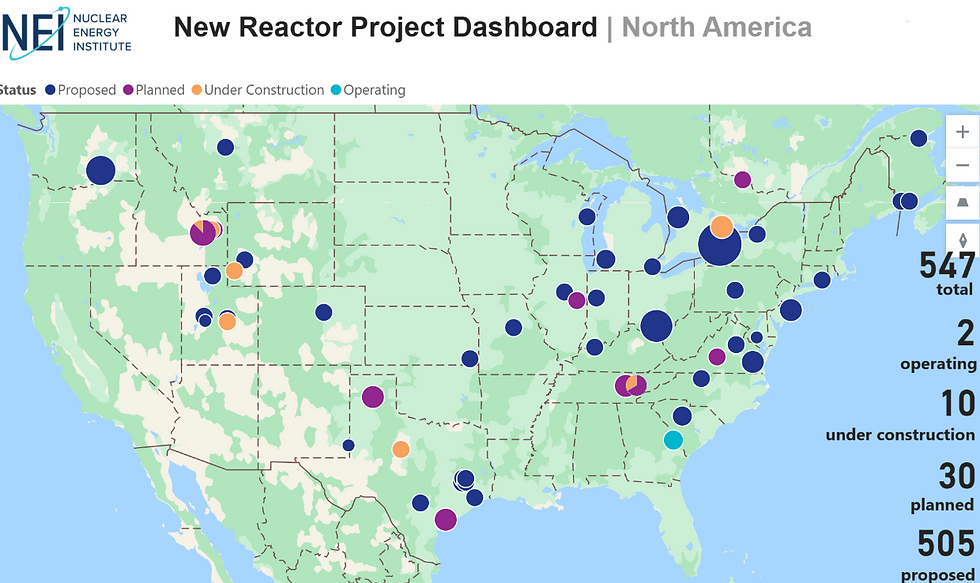
For students, policymakers, and homeowners alike, the nuclear debate offers no easy answers. While policymakers must weigh the necessity of nuclear energy against its economic risks, homeowners are forced to decide if a nearby reactor marks the beginning of a golden age for their neighborhood, or if it instead foreshadows economic disaster. As Figure 4 shows, 505 nuclear reactors are currently proposed across the United States; a choice will need to be made soon.
For students, the best they can do is stay educated on the benefits and drawbacks of nuclear energy, so when their time comes to make a decision on this controversial power source, they know where their loyalties lie. Ultimately, whether the shift towards nuclear energy results in lasting regional wealth or not will depend on how we balance the promise of a near-limitless energy supply against the risk of economic disaster.
References:
Bezdek, R.H. and Wendling, R.M. (2006) ‘The impacts of nuclear facilities on property values and other factors in the surrounding communities’, Int. J. Nuclear Governance.
Clark, D.B. and Allison, T. (1999) ‘Spent nuclear fuel and residential property values: the influence of proximity, visual cues and public information’, Papers in Regional Science, Vol. 78, pp.403–421.
Trinity Street Capital Partners (2025, November 19). Nuclear Power 's impact on real estate. https://trinitystreetcp.com/commercial-real-estate/nuclear-power-and-its-impact-on-real-estate/
Paul, Robert (2011, March 23) What happens to home values if you live near a nuclear reactor? https://www.robertpaulsells.com/blog/what-happens-to-home-values-if-you-live-near-a-nuclear-reactor-prism-money-analysis-opinion/
Lewis, Morgan (2019, January 31) New Study Analyzes Effect on Property Values When Nuclear Power Plants Shut Down https://www.lexology.com/library/detail.aspx?g=06ef7427-fc58-431e-aa3a-740a40301eea
McKinsey & Company. (2023, August 1). The state of AI in 2023: Generative AI’s breakout year. McKinsey & Company. https://www.mckinsey.com/capabilities/quantumblack/our-insights/the-state-of-ai
Johnson, Nathaneal. (2022, Jan 11). Save the Nukes? https://grist.org/climate-energy/nuclear-rally-environmentalists-try-to-save-diablo-canyon-power-plant/
Nuclear Energy Institute, https://www.nei.org/
Hanwha Data Centers. (2025, July 2). Top Digital Infrastructure Trends for AI-Driven Data Centers in 2025. https://www.hanwhadatacenters.com/blog/top-digital-infrastructure-trends-for-ai-driven-data-centers/
Dieter (2025, Feb 5). 5 Fast Facts About Nuclear Energy in the US. https://www.skillzme.com/5-fast-facts-nuclear-energy-infographic/
Munro, Tolley (2018). Property Values and Tax Rates near Spent Nuclear Storage
Meher, Christina (2020). The Economic Impacts of Nuclear Power Plant Closures on Rural Communities. https://repository.rit.edu/cgi/viewcontent.cgi?article=11737&context=theses


