From Memes to Markets: How Retail Investors Are Rewriting the Rules of Volatility

In January 2021, shares of GameStop (GME) surged more than 1,500% in a matter of weeks, stunning Wall Street and capturing global attention. This dramatic rise was not driven by traditional financial fundamentals such as earnings or growth projections; it was fueled by millions of everyday investors coordinating through Reddit's WallStreetBets forum, armed with nothing more than smartphones and free brokerage accounts. For the first time at this scale, retail investors, individual, non-professional traders, appeared to wield collective power strong enough to rattle hedge funds managing billions of dollars.
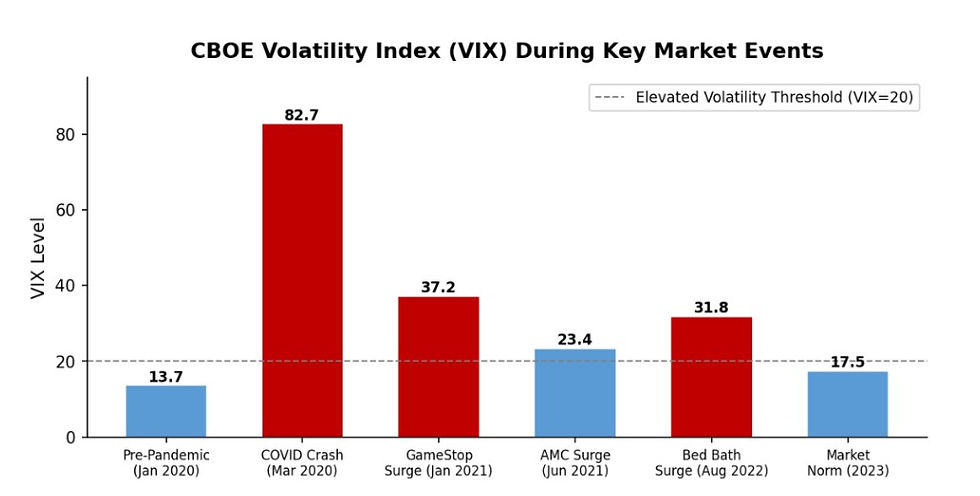
The financial world had always assumed that markets were governed by sophisticated algorithms, institutional research desks, and decades of risk modeling. GameStop shattered that assumption in a matter of days. As volatile price action swept across GameStop, AMC, and Bed Bath & Beyond, the question became unavoidable: Can large groups of small investors truly move markets that have historically been controlled by hedge funds, banks, and other institutional players?
The democratization of trading through commission-free platforms, combined with the viral nature of social media, has created a new class of highly engaged retail investors capable of driving significant short-term price volatility, particularly during meme-stock events. However, while retail investors have disrupted traditional market dynamics, institutional players have not been displaced. Instead, they have adapted, developing sophisticated strategies to exploit, hedge, and profit from retail-driven behavior, reinforcing their long-term dominance in financial markets.
The Democratic Disruption: How Commission-Free Trading Rebuilt Market Access
The introduction of commission-free trading platforms has fundamentally reshaped who participates in financial markets. Historically, trading stocks involved brokerage fees that discouraged frequent transactions, particularly among smaller investors. Platforms like Robinhood eliminated these fees entirely, lowering the barrier to entry and enabling a generation of new participants. Even-Tov et al. (2023) found that when trading fees are removed, retail investors engage more frequently and, in some cases, achieve better outcomes due to increased participation. Similarly, Cao et al. (2021) documented a surge in brokerage account openings during the COVID-19 pandemic, with millions of new users entering the market for the first time.
This influx of retail investors represents a structural shift in market participation that has outlasted the pandemic era. As shown in Figure 1, retail investors grew from approximately 12–14% of U.S. equity volume in 2017–2019 to roughly 25% by 2021, a nearly twofold increase driven by platform accessibility and pandemic-era stimulus checks that left millions with both time and disposable income. Zhang (2023) argues that the gamified design of trading platforms, featuring push notifications, visual progress bars, and instant trade confirmations, further encourages speculative behavior by making financial decision-making feel more like interactive entertainment than deliberate investment. This design philosophy, while expanding market access, also increases the likelihood of impulsive, high-frequency trading behavior among novice users.

The consequence of this democratization extends beyond individual accountancy activity. When millions of individual trades begin moving in the same direction simultaneously, their aggregate market impact approaches the scale of institutional orders. Liu et al. (2024) found that retail trading activity exhibits measurable co-movement, investors buying and selling the same securities in synchronized patterns driven by shared narratives, not financial analysis. These collective dynamic transforms retail participation from a passive market phenomenon into an active price-moving force, particularly in lower-float, heavily shorted stocks where supply constraints magnify the impact of concentrated demand.
The Chaos Unleashed: Meme Stocks, Gamma Squeezes, and the Anatomy of Retail-Driven Volatility
The most consequential manifestation of retail investor power is its capacity to generate extreme short-term price volatility, particularly through the mechanics of gamma squeezes and short squeezes. These are not merely dramatic stories of market disruption; they are technically precise phenomena rooted in options market dynamics and forced institutional position liquidation.

During the GameStop event, retail investors on WallStreetBets began purchasing large volumes of short-dated call options on GME, a stock with short interest exceeding 140% of its available float. This created the conditions for a gamma squeeze. When retail investors buy call options, market makers who sell those contracts must hedge their exposure by purchasing the underlying shares, which is a process called delta hedging. As GME's price rose and the options moved deeper in-the-money, market makers were forced to buy increasing quantities of shares to maintain a neutral position. This mechanical buying pressure accelerated the price rise, which triggered more options activity, which forced more hedging, a self-reinforcing feedback loop entirely distinct from any change in GameStop's underlying fundamentals (Saba et al., 2022).
Simultaneously, the elevated stock price forced short sellers, many of them institutional hedge funds, to execute short squeezes. Funds holding short positions faced mounting unrealized losses as GME climbed. Once losses became unsustainable, they were compelled to buy shares to close their positions, adding further upward momentum to an already explosive price movement. Melvin Capital, one of the most prominent victims, reported losses exceeding $6.8 billion during January 2021 alone, requiring an emergency capital injection from Citadel and Point72 to remain solvent (Roche et al., 2023).
As shown in Figure 3, these dynamics produced dramatic spikes in the CBOE Volatility Index (VIX). The GameStop surge pushed the VIX to 37.2, a level not seen outside of genuine macro crises. Kinahan et al. (2026) emphasize that this volatility was amplified by psychological factors among young retail investors, including distrust of financial institutions, desire for rapid gains, and intense social pressure not to "paper hand" (sell prematurely). Whittle and Mills (2024) frame this behavior not merely as speculation but as a form of cultural protest, young investors treating the market as an arena for collective resistance against hedge fund dominance.
The Institutional Adaptation: How Wall Street Learned to Exploit the Disruption
Despite the chaos retail investors created, institutional players have not retreated, they have evolved. What initially appeared as a threat to institutional dominance has become an exploitable source of alpha, as hedge funds, market makers, and investment banks developed tailored strategies to profit from and hedge against retail-driven volatility.
The most important development is the institutionalization of retail flow monitoring. Goldman Sachs (2025) reports that major firms now maintain dedicated desks tracking real-time retail options activity, WallStreetBets post volumes, and social media sentiment using natural language processing (NLP) tools. By identifying retail accumulation patterns before they reach critical mass, institutions can front-run anticipated price moves, entering positions early, riding the retail-fueled wave, and exiting before the inevitable reversal. This is not passive observation; it is a systematized trading strategy that converts retail enthusiasm into institutional profit.

Beyond monitoring, institutions have developed specific derivative strategies to capture value from retail-created volatility. Volatility arbitrage has emerged as a particularly effective tool: when meme-stock events drive implied volatility (IV) to abnormally elevated levels, institutional traders sell high-premium options contracts, collecting the inflated time value. After the GameStop peak on January 28, 2021, the implied volatility on GME options collapsed dramatically as retail momentum dissipated, a phenomenon known as IV crush. Institutions that sold options at peak IV profited from both the premium collected and the rapid decline in option value. In effect, retail-driven panic became a reliable income-generating event for sophisticated players who understood the mechanics (Goldman Sachs, 2025).
Gamma squeeze dynamics, while initially benefiting retail investors, have also been reverse-engineered. Market-making firms such as Citadel Securities, counterintuitively operating on both sides of the GameStop saga, profited enormously from the elevated bid-ask spreads generated by extreme trading volume. During the GameStop surge, Citadel Securities processed over 7.4 billion shares in a single week, capturing a fraction of the spread on each transaction in a market where volatility and volume were simultaneously maximal. Roche et al. (2023) note that while several hedge funds sustained catastrophic losses, the broader institutional ecosystem makers, clearinghouses, and prime brokers benefited directly from the chaos. This systemic resilience underscores that institutional adaptation is not merely defensive but actively profitable.
Moreover, the events of 2021 produced lasting structural changes in institutional risk management. Many hedge funds have since reduced their exposure to stocks with high short interest relative to floating, specifically to avoid the vulnerability that felled Melvin Capital. Others have implemented algorithmic tripwires that automatically reduce short exposure when social media mentions that the velocity for a given ticker exceeds a threshold, a direct operational response to the retail threat. These changes represent a learning curve that strengthens institutional dominance over time: each successive meme-stock event is less surprising and more profitable for prepared institutional players.
Conclusion
The rise of retail investors has fundamentally altered the texture of short-term market behavior. Through commission-free trading platforms, options market dynamics, and social media-coordinated collective action, individual investors demonstrated the capacity to create genuine financial crisis-level volatility in specific securities, an outcome few market observers predicted before January 2021. The gamma squeeze, short squeeze, and VIX spikes that characterized the meme-stock era are not isolated anomalies; they represent a repeatable market phenomenon rooted in structural features of modern equity and options markets.
Yet institutional dominance has not been displaced; it has been reconfigured. Where retail investors see disruption, institutional players see opportunity. From volatility arbitrage and options premium harvesting to NLP-driven sentiment monitoring and reduced short exposure in high-risk names, Wall Street has responded with characteristic adaptability. The evidence suggests that each meme-stock event ultimately transfers value from unsophisticated retail participants, who often buy at peaks and sell into reversals, to institutions positioned to exploit the mechanics of those very events.
For individual investors, this analysis carries a clear recommendation: understanding the mechanics behind market phenomena matters as much as participating in them. Collective action can create short-term opportunities, but without an exit strategy calibrated to institutional behavior, specifically, the predictable IV crush and momentum reversal that follows every retail surge, retail participants are more likely to be the exit liquidity than the beneficiaries. For policymakers, the continued growth of retail participation raises unresolved questions about options market accessibility, gamification regulation, and whether existing investor protection frameworks are adequate for a trading environment where a Reddit post can move a stock more than an earnings report. The power of retail investors lies not in replacing institutional dominance, but in redefining the conditions under which that dominance operates, which Wall Street is already, methodically, learning to control.
References:
Cao, J., Han, B., Huang, Z., & Li, D. (2021). Who participated in the GameStop frenzy? Evidence from brokerage accounts. The Financial Review. https://doi.org/10.1111/fire.12292
Even-Tov, O., et al. (2023, June 20). Absent fees, retail traders do better. UC Berkeley Haas Newsroom. https://haas.berkeley.edu/news/absent-fees-retail-traders-do-better
Goldman Sachs. (2025, July 23). Revenge of the meme stocks [Podcast transcript].
Goldman Sachs. (2022, June 1). The meme stock revolution is over. Yahoo Finance.
Kinahan, J., et al. (2026, January 29). GameStop mania fed off angst among young investors. CNBC.
Liu, X., Wang, Y., & Zhang, T. (2024). Retail traders and co-movement. Journal of International Financial Markets.
Roche, D., et al. (2023, February 6). Hedge funds caught in bigger squeeze. Reuters.
Saba, R., et al. (2022). The GameStop episode. Cato Journal, 42(3), 555–582.
Whittle, R., & Mills, S. (2024). The GameStop short squeeze. The Conversation.
Zhang, L. (2023). Robinhood's retail investing app. Journal of Behavioral Finance and Markets.


